

LoveChip が 2025年10月17日15時12分27秒 に編集
初版
タイトルの変更
What Is a Digital Potentiometer IC?
タグの変更
ICs
Digital
Electronics
semiconductor
メイン画像の変更
記事種類の変更
製作品
本文の変更
In modern electronics, precision and automation have transformed even the simplest components. One such evolution is the digital potentiometer IC — a compact, programmable device that performs the same role as a traditional analog potentiometer, but under digital control. If you’ve ever adjusted the volume on an analog radio, you’ve used a potentiometer. But what if that adjustment could be done automatically, with high precision, via microcontrollers or DSPs? That’s where the digital potentiometer comes in. **Overview: What Is a Digital Potentiometer IC?** A digital potentiometer (often called digipot) is an integrated circuit (IC) that emulates the function of a mechanical potentiometer using digital signals. It consists of an array of resistors and electronic switches (MOSFETs) that divide the resistance into discrete steps. 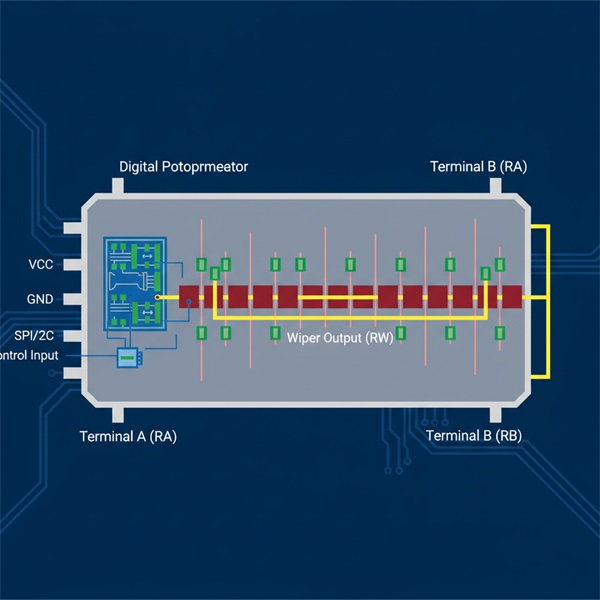 Unlike a traditional pot with a physical wiper, the wiper position in a digipot is controlled by digital logic — typically through communication interfaces such as SPI (Serial Peripheral Interface) or I²C (Inter-Integrated Circuit). In essence, it’s a digitally programmable resistor network that enables precise control of analog signals. **How Does a Digital Potentiometer Work?** The internal architecture of a digital potentiometer is based on three key components: 1.Resistor String: A series of equal-value resistors form the resistance ladder. 2.Electronic Switch Network: MOSFETs connect or disconnect taps along the resistor string, simulating the motion of a mechanical wiper. 3.Digital Control Logic: An internal register stores the digital code that determines which switch is active. This value is set through serial communication (e.g., SPI or I²C commands). Each digital code corresponds to a specific resistance ratio between the terminals: [ R_{WB} = \frac{D}{2^n - 1} \times R_{AB} ] Where: ●( R_{AB} ): total resistance between end terminals A and B ●( R_{WB} ): resistance between wiper (W) and terminal B ●( D ): digital value (0–255 for 8-bit device) ●( n ): resolution in bits By changing ( D ), the wiper position moves electronically — allowing the resistance to be set precisely in discrete steps. **Key Features and Advantages** Digital potentiometers offer several advantages over traditional mechanical pots: Feature Digital Potentiometer Analog Potentiometer Control Method Digital (via MCU or DSP) Manual (rotary or slide) Precision High, defined by bit resolution (e.g., 8-bit, 10-bit) Depends on physical tolerance Wear and Reliability No mechanical wear Subject to mechanical wear and drift Automation Fully programmable Manual only Memory Options Volatile or non-volatile (EEPROM) Not applicable Size & Integration Compact IC package Bulky mechanical form These advantages make digital potentiometers ideal for automated calibration, remote signal tuning, and precise analog control loops. **Types of Digital Potentiometers** Digital potentiometers are categorized by resistance value, interface type, memory retention, and resolution. 1. Based on Interface: ●SPI Digital Potentiometers – Fast and simple serial protocol; suitable for high-speed applications. ●I²C Digital Potentiometers – Ideal for multi-device control on the same bus. 2. Based on Memory Type: ●Volatile Digipots: Lose wiper setting when power is off (e.g., AD5206). ●Non-Volatile Digipots: Retain the last setting using EEPROM (e.g., MCP41HV51, DS3502). 3. Based on Resolution: ●Low-resolution (6–8 bit) – 64 to 256 steps, used in basic tuning. ●High-resolution (10–12 bit) – Up to 4096 steps, ideal for precision control. **Common Specifications** Parameter Typical Range Supply Voltage (Vdd) 2.7V to 5.5V (some up to ±15V) Total Resistance (R_AB) 1kΩ to 1MΩ Resolution 6-bit to 12-bit Interface SPI, I²C, Up/Down Wiper Resistance 50Ω – 200Ω typical Operating Temperature -40°C to +125°C  **Applications of Digital Potentiometer ICs** [Digital potentiometers ](https://www.avaq.com/category/integrated-circuits-ics/digital-potentiometer-ics)appear in a broad range of analog and mixed-signal systems, often replacing manual trimming or calibration. 1. Audio Volume and Tone Control Used to digitally adjust amplifier gain or equalizer tone settings — without mechanical knobs. 2. Sensor Calibration Fine-tunes offset or sensitivity in temperature, pressure, or optical sensors. 3. Power Supply Adjustment Controls feedback resistors in voltage regulators for digital control of output voltage. 4. Data Acquisition Systems Provides programmable gain or offset calibration in ADC front ends. 5. Motor Control and LED Dimming Enables dynamic resistance tuning for speed or brightness control. 6. Automatic Test Equipment (ATE) Allows automated, repeatable resistance changes for calibration and testing. Digital Potentiometer vs. DAC (Digital-to-Analog Converter) Though they may sound similar, digital potentiometers and DACs serve different purposes. Parameter Digital Potentiometer DAC Function Adjustable resistor Voltage output converter Output Type Resistance ratio Analog voltage Resolution 6–12 bits 8–16 bits typical Use Case Analog signal scaling Precise voltage generation While a DAC outputs a voltage level directly, a digipot adjusts resistance, influencing analog circuits indirectly — such as amplifier gain or bias points. **Limitations of Digital Potentiometers** Despite their advantages, digipots have practical constraints: ●Limited current handling – typically under 10 mA per terminal. ●Finite resolution – cannot provide truly continuous resistance. ●Temperature coefficient – resistance changes slightly with temperature. ●Wiper resistance – adds a small but non-negligible offset in precision designs. For applications requiring very low noise or high current, a digital potentiometer may not be suitable. Design-In Tips 4.Choose Appropriate Resistance Range: Select ( R_{AB} ) that suits your voltage divider or feedback network. 5.Account for Wiper Resistance: Include ( R_W ) in your calculations, especially in precision op-amp circuits. 6.Power Supply Decoupling: Always place bypass capacitors (0.1 µF and 10 µF) near the IC to ensure stability. 7.Non-Volatile Preference: Use EEPROM-based digipots if settings must persist after power-off. 8.Communication Speed: For fast or frequent adjustments, prefer SPI-based digipots due to their speed and simplicity. **Popular Digital Potentiometer IC Models** Manufacturer Model Interface Resistance Non-Volatile Notes Analog Devices AD5262 I²C 50kΩ No Dual-channel 8-bit Microchip MCP4131 SPI 10kΩ No Single, 256 steps Maxim Integrated DS3502 I²C 10kΩ Yes Non-volatile 7-bit Texas Instruments TPL0102 I²C 100kΩ Yes Dual, 256 positions Renesas X9C104 Up/Down 100kΩ Yes Simple interface, legacy device **Digital Potentiometer in Modern Electronics** Today’s digital potentiometers are found in almost every embedded system requiring adjustable analog parameters. They are widely integrated into IoT devices, smart sensors, and precision control systems, where remote programmability and repeatability are essential. As analog and digital domains continue to merge, the digital potentiometer bridges the gap — offering the flexibility of software control with the precision of analog circuitry. **Wrapping Up** A digital potentiometer IC is more than a modern replacement for the mechanical knob — it’s a precision, software-controlled component that brings automation and reliability to analog design. From audio systems to calibration circuits, these devices are essential wherever fine-tuned analog control meets digital intelligence. With continued advances in mixed-signal technology, digital potentiometers will remain a cornerstone of smart, adaptive electronics. **FAQs About Digital Potentiometer ICs** Q1: Can a digital potentiometer replace any analog potentiometer? Not always. It can replace analog pots in low-power signal circuits but not in high-current or high-voltage paths. Q2: What determines the accuracy of a digital potentiometer? The bit resolution, total resistance tolerance, and temperature coefficient. Q3: Is the wiper position saved after power-off? Only in non-volatile models; volatile types reset to default on power-up. Q4: Can I use a digital potentiometer for audio volume control? Yes, many digipots are designed for audio applications with low noise and smooth step transitions. Q5: What’s the difference between I²C and SPI digipots? SPI digipots offer faster data rates; I²C supports multiple devices on a single bus with simpler wiring.