




仕様
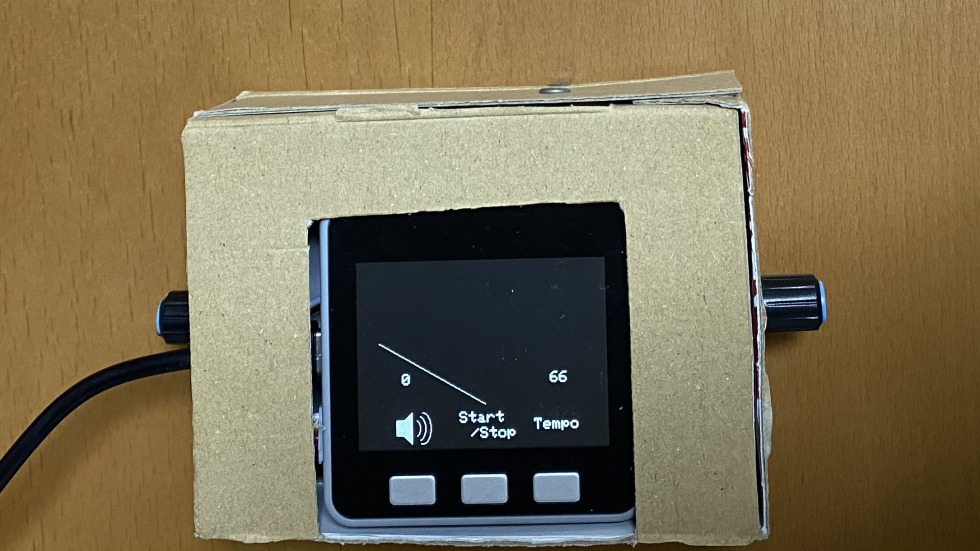
ずっと欲しかった、電子メトロノームをM5Stackを使って作ってみました。
機能は以下の通りです。
- start/stop ボタンでメトロノームをON/OFF
- 左のつまみを回すことで音量を調整
- 右のつまみを回すことでテンポを調整
デモ動画
部品
接続図
各モジュールを次の写真のように接続します。
プログラム
metoronome.ino
#include <M5Stack.h>
#include <Wire.h>
#include "porthub.h"
PortHub porthub;
uint8_t HUB_ADDR[2]={HUB5_ADDR,HUB6_ADDR}; //HUB5_ADDR: 5から入力されたアングル HUB6_ADDR: 6から入力されたアングル
float x[20];
float y[20];
int tempos[223];
int tempos1[223];
int volumes[60];
int volume = 1; //現在の音量
int b_volume = 1; //1個前の音量
int tempo = 60; //現在のテンポ
int b_tempo = 60; //一個前のテンポ
int angle5; //5から入力された角度
int b_angle6; //6から入力された現在の角度
int c_angle6; //6から入力された一個前の角度
float interval = 100;
int n = 0; //針が何番目の位置にあるか
int tempoi = 15; //tempos[tempoi]
int volumei = 0; //volumes[volumei]
int homeBtnB = 0; //メトロノームが動いていたら1
int temposetting1 = 0; //テンポ設定中(テンポは1ずつ変化)かどうか
unsigned long start;
int skip = 0;
void setup(){
M5.begin();
M5.Power.begin();
porthub.begin();
M5.Speaker.begin(); // ノイズをミュート
M5.Speaker.mute();
homemark();
/*テンポ-----------------------------------*/
tempos[0]=30;
b_angle6 = porthub.hub_a_read_value(HUB_ADDR[1]);
for (int i=0; i<223; ){
if(i < 30){
for (int j = 0; j < 2; j++){
tempos[i + j] = i + 30;
}
i += 2;
}else if(i < 42){
for (int j = 0; j < 3; j++){
tempos[i + j] = i + 30;
}
i += 3;
}else if(i < 90){
for (int j = 0; j < 4; j++){
tempos[i + j] = i + 30;
}
i += 4;
}else if(i < 114){
for (int j = 0; j < 6; j++){
tempos[i + j] = i + 30;
}
i += 6;
}else if(i < 210){
for (int j = 0; j < 8; j++){
tempos[i + j] = i + 30;
}
i += 8;
}else if(i < 222){
for (int j = 0; j < 12; j++){
tempos[i + j] = i + 30;
}
i += 12;
}else{
tempos[i] = 252;
i ++;
}
}
for (int i=0; i< 223; i++){
tempos1[i] = i + 30;
}
/*音量-----------------------------------*/
for(int i=0; i < 60; i++){
if(i < 11){
volumes[i] = i;
}else{
volumes[i] = volumes[i -1] + 5;
}
}
/*針の座標-----------------------------------*/
for (int i=0; i < 20; i++){
if(i < 11){
x[i] = 164 + 160*cos(5*PI/6 - i*PI/15);
y[i] = 180 - 160*sin(5*PI/6 - i*PI/15);
}else{
x[i] = x[20-i];
y[i] = y[20-i];
}
}
}
void loop(){
M5.update();
/*メトロノームの針---------------------------*/
if(m5.BtnB.wasPressed()){
homeBtnB = 1 - homeBtnB;
}
if(homeBtnB == 1){
M5.Lcd.drawLine(164,180,x[n],y[n],WHITE);
if(n == 0 || n == 10){ //針が端に来た時に音を鳴らす
beep(932, 100, volume);
}
if(volume > 0){
if((interval - 10 - millis() + start) >= 0){
skip = 0;
delay(interval - 10 - millis() + start);
}else if((interval*2 - 20 - millis() + start) >= 0) {
skip = 1;
delay(interval*2 - 20 - millis() + start);
}
}else{
if((interval - 10 - millis() + start) >= 0){
skip = 0;
delay(interval - 10 - millis() + start);
}else if((interval*2 - 20 - millis() + start) >= 0) {
skip = 1;
delay(interval*2 - 20 - millis() + start);
}
}
if((interval - millis() + start) >= 0){
skip = 0;
delay(interval - millis() + start);
}else if((interval*2 - millis() + start) >= 0) {
skip = 1;
delay(interval*2 - millis() + start);
}
M5.Lcd.drawLine(164,180,x[n],y[n],BLACK);
if(n < 19){
n += skip +1;
}else{
n = 0;
}
}else{
M5.Lcd.drawLine(164,180,x[0],y[0],WHITE);
n = 0;
}
start = millis();
/*音量調節-------------------------------*/
angle5 = porthub.hub_a_read_value(HUB_ADDR[0]);
if((angle5/11.8) < 60){
volumei = angle5/11.8;
}else{
volumei = 59;
}
volume = volumes[volumei];
if(volume != b_volume){
M5.Lcd.setCursor(55,140);
M5.Lcd.setTextColor(BLACK);
M5.Lcd.println(b_volume);
M5.Lcd.setCursor(55,140);
M5.Lcd.setTextColor(WHITE);
M5.Lcd.println(volume);
b_volume = volume;
}
/*テンポ調節---------------------------------*/
if(tempo != b_tempo){
M5.Lcd.setTextColor(BLACK);
M5.Lcd.setCursor(250,140);
M5.Lcd.println(b_tempo);
M5.Lcd.setTextColor(WHITE);
M5.Lcd.setCursor(250,140);
M5.Lcd.println(tempo);
b_tempo = tempo;
}
if(m5.BtnC.wasPressed()){ //Cボタンが押されたら1ずつ変化
temposetting1 = 1 - temposetting1;
}
b_angle6 = c_angle6;
c_angle6 = porthub.hub_a_read_value(HUB_ADDR[1]); //6から入力せれた角度
if((c_angle6 / 3.07) < 223){
tempoi = c_angle6 / 3.07;
}else{
tempoi = 222;
}
if(temposetting1 == 0){
M5.Lcd.drawFastHLine(247,158,39,BLACK); //下線を消す
if(c_angle6 != b_angle6){
tempo = tempos[tempoi];
}
}else{
if(tempo < 100){
M5.Lcd.drawFastHLine(273,158,13,BLACK); //余分な下線を消す
M5.Lcd.drawFastHLine(247,158,26,WHITE); //下線を引く
}else{
M5.Lcd.drawFastHLine(247,158,39,WHITE); //下線を引く
}
if(c_angle6 != b_angle6){
tempo = tempos1[tempoi];
}
}
interval = 6000 / tempo ; //BPMを間隔に変換
}
/*homeマーク----------------------------------------*/
void homemark(){
M5.Lcd.fillRect(0,181,330,60,BLACK);
volumemark();
startstopmark();
Tempomark();
}
/*音量マーク----------------------------------------*/
void volumemark(){
M5.Lcd.fillRect(47,200,10,20,WHITE);
M5.Lcd.fillTriangle(67,190,67,230,47,210,WHITE);
M5.Lcd.drawEllipse(81,210,11,20,WHITE);
M5.Lcd.fillRect(68,190,13,40,BLACK);
M5.Lcd.drawEllipse(77,210,8,15,WHITE);
M5.Lcd.fillRect(68,190,10,40,BLACK);
M5.Lcd.drawEllipse(73,210,5,10,WHITE);
M5.Lcd.fillRect(68,190,6,40,BLACK);
M5.Lcd.setCursor(55,140);
M5.Lcd.setTextColor(WHITE);
M5.Lcd.println(volume);
}
/*Start/Stop----------------------------*/
void startstopmark(){
M5.Lcd.setCursor(130,190);
M5.Lcd.setTextColor(WHITE);
M5.Lcd.setTextSize(2);
M5.Lcd.println("Start");
M5.Lcd.setCursor(145,210);
M5.Lcd.println("/Stop");
}
/*Tempo-------------------------------*/
void Tempomark(){
M5.Lcd.setCursor(228,200);
M5.Lcd.setTextColor(WHITE);
M5.Lcd.print("Tempo");
M5.Lcd.setCursor(250,140);
M5.Lcd.setTextColor(WHITE);
M5.Lcd.setTextSize(2);
M5.Lcd.println(tempo);
}beep.ino
#include <M5Stack.h>
#define SPEKAER_PIN 25
void beep(int freq, int duration, uint8_t volume0){
// freq(Hz), duration(ms), volume0(1~255)
int t = 1000000 / freq / 2;
unsigned long start = millis();
while((millis() - start) < duration){
dacWrite(SPEAKER_PIN, 0);
delayMicroseconds(t);
dacWrite(SPEAKER_PIN, volume0);
delayMicroseconds(t);
}
dacWrite(SPEAKER_PIN, 0);
}porthub.cpp
#include "porthub.h"
PortHub::PortHub(){
}
void PortHub::begin(){
Wire.begin();
}
uint16_t PortHub::hub_a_read_value(uint8_t reg){
Wire.beginTransmission(IIC_ADDR);
Wire.write(reg | 0x06);
Wire.endTransmission();
uint8_t RegValue_L,RegValue_H;
Wire.requestFrom(IIC_ADDR,2);
while(Wire.available()){
RegValue_L = Wire.read();
RegValue_H = Wire.read();
}
return (RegValue_H<<8) | RegValue_L;
}porthub.h
#ifndef __PORTHUB_H__
#define __PORTHUB_H__
#include <Wire.h>
#define IIC_ADDR 0x61
#define HUB1_ADDR 0x40
#define HUB2_ADDR 0x50
#define HUB3_ADDR 0x60
#define HUB4_ADDR 0x70
#define HUB5_ADDR 0x80
#define HUB6_ADDR 0xA0
class PortHub {
public:
PortHub();
void begin();
uint16_t hub_a_read_value(uint8_t reg);
uint8_t hub_d_read_value_A(uint8_t reg);
uint8_t hub_d_read_value_B(uint8_t reg);
void hub_d_wire_value_A(uint8_t reg,uint16_t level);
void hub_d_wire_value_B(uint8_t reg,uint16_t level);
void hub_a_wire_value_A(uint8_t reg,uint16_t duty);
void hub_a_wire_value_B(uint8_t reg,uint16_t duty);
void hub_wire_length(uint8_t reg,uint16_t length);
void hub_wire_index_color(uint8_t reg,uint16_t num,uint8_t r,int8_t g,uint8_t b);
void hub_wire_fill_color(uint8_t reg,uint16_t first, uint16_t count, uint8_t r,int8_t g,uint8_t b);
void hub_wire_setBrightness(uint8_t reg,uint8_t brightness);
public:
private:
private:
};
#endifporthub.cpp、porthub.h は、
ファイル→スケッチ例→M5Stack→Unit→PbHUB
で開くことのできるスケッチ例を参考にしてます。
組み立て
大まかに下図のように段ボールを切り取って組み立てます。
終わりに
M5Stackを使って、とても簡単に電子メトロノームが作れたので満足しています。
正確で、かなり大きな音が出せるので使いやすいです。
M5Stackはまだまだいろんなことができそうなので、また何か作ってみようと思います!


-
mint
さんが
2021/02/28
に
編集
をしました。
(メッセージ: 初版)
ログインしてコメントを投稿する