


はじめに
初めまして、ぽこりんたラボラトリです!
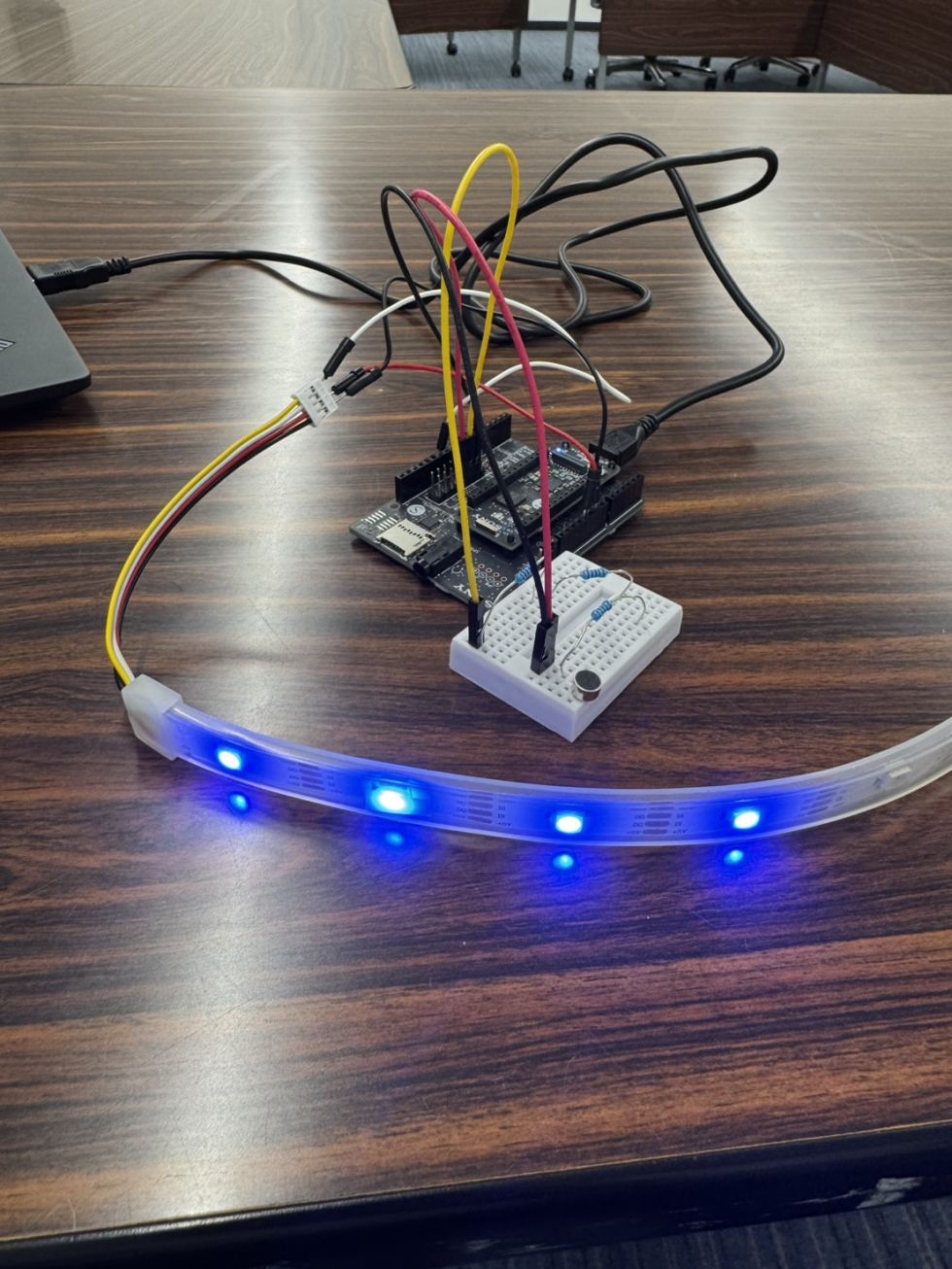
今回2025年SPRESENSE活用コンテストに応募し、SPRESENSEを用いてマイクから音声を受け取りFFT解析してその音量や周波数に応じてLEDテープを光らせてみました!
お詫びと言い訳
本題に入る前にいきなりですが、今回のコンテストではディスプレイもご提供いただいていたのですが、開発が間に合わず使用することができませんでした。
当初はSpresense SDKを用いて開発しようとしていたのですが、組み込み素人の私では解析が間に合わなかったため急遽Arduino環境による開発に移行したため、ディスプレイを使用するところまで到達できませんでした。
ちょっとプログラミングができるからと言って無茶はよくなかったですね...精進します。
概要
では本題に入っていきます。
今回行ったのは前述のとおりですが、中身の処理は大別すると以下の二つに分けられます。
- マイクから入力を受け取り、FFT解析を行う。
- FFT解析の結果から音量とスペクトルのピーク周波数を抽出し、音量に合わせて光らせるLEDの数、ピーク値に合わせて色を変化させる。
FFT解析はサブコアで行い、LEDの点灯はメインコアで行っています。
構成
使用部品
- SPRESENSE メインボード
- SPRESENSE 拡張ボード
- エレクトリックコンデンサーマイク(WM-61A相当品)
- WS2813(LEDテープ)
Pinアサイン
| 使用部品 | ピン名称 |
|---|---|
| マイク+ | MICA |
| マイク+ | MIC BIAS A(2.2 kΩの抵抗付き) |
| マイク- | GND |
| LED+ | Vout 5V |
| LED- | GND |
| LED通信線 | D11 |
それぞれのピン名称はSPRESENSE Developmentのハードウェア構成およびマイクに関してはマイクの使用方法を参照してください。
今回使用しているマイクは推奨品のものとは違いますが、推奨品とほぼ同じスペックでかつマイクの出力インピーダンスが負荷抵抗の値になるという記述があったので、マイクバイアスへの入力には2.2 kΩの負荷抵抗をつけています。
(もしこの理解が間違っていたらご指摘ください)
また実装の章でも触れますが、今回LEDの制御にはSPIピンを使用しています。
実装
今回は先人の知恵を大いに活用させていただきました。
SPRESENSE Arduino 開発ガイドのSignalProcessing チュートリアルをベースにしています。
LEDの制御はこちらのライブラリを使用させていただきました。こちらはArduino IDEのLibrary Managerには載っていないので、GithubからZIPファイルでダウンロードしてインポートする必要があります。
メインコア
/*
* MainAudio.ino - FFT Example with Audio (Sound Detector)
* Copyright 2019 Sony Semiconductor Solutions Corporation
*
* This library is free software; you can redistribute it and/or
* modify it under the terms of the GNU Lesser General Public
* License as published by the Free Software Foundation; either
* version 2.1 of the License, or (at your option) any later version.
*
* This library is distributed in the hope that it will be useful,
* but WITHOUT ANY WARRANTY; without even the implied warranty of
* MERCHANTABILITY or FITNESS FOR A PARTICULAR PURPOSE. See the GNU
* Lesser General Public License for more details.
*
* You should have received a copy of the GNU Lesser General Public
* License along with this library; if not, write to the Free Software
* Foundation, Inc., 51 Franklin St, Fifth Floor, Boston, MA 02110-1301 USA
*/
#include <MP.h>
#include <Audio.h>
#include <SPI.h>
#include <SPI_NeoPixel.h>
//https://github.com/lipoyang/SPI_NeoPixel
AudioClass *theAudio;
/* Select mic channel number */
const int mic_channel_num = 1;
const int subcore = 1;
const int MAX_POWER = 200; // 表示する音量の最大値
const float MAX_FREQ = 3000.0f; // 最大周波数;
const int NUM_PIXELS = 30; //NeopixelのLED数
//spiの送信のピン = 11
SPI_NeoPixel neopixel(NUM_PIXELS);
struct Request {
void *buffer;
int sample;
int channel;
};
struct Result {
bool found[mic_channel_num];
float power[mic_channel_num];
float peak[mic_channel_num];
int channel;
};
void setup()
{
Serial.begin(115200);
delay(1000);
while (!Serial);
neopixel.begin();
neopixel.clear();
Serial.println("Init Audio Library");
theAudio = AudioClass::getInstance();
theAudio->begin();
Serial.println("Init Audio Recorder");
/* Select input device as AMIC */
theAudio->setRecorderMode(AS_SETRECDR_STS_INPUTDEVICE_MIC, 210);
/* Set PCM capture */
uint8_t channel;
switch (mic_channel_num) {
case 1: channel = AS_CHANNEL_MONO; break;
case 2: channel = AS_CHANNEL_STEREO; break;
case 4: channel = AS_CHANNEL_4CH; break;
}
theAudio->initRecorder(AS_CODECTYPE_PCM, "/mnt/spif/BIN", AS_SAMPLINGRATE_48000, channel);
/* Launch SubCore */
int ret = MP.begin(subcore);
if (ret < 0) {
printf("MP.begin error = %d\n", ret);
}
/* receive with non-blocking */
MP.RecvTimeout(1);
Serial.println("Rec start!");
theAudio->startRecorder();
}
void loop()
{
int8_t sndid = 100; /* user-defined msgid */
int8_t rcvid = 0;
Request request;
Result* result;
static const int32_t buffer_sample = 768 * mic_channel_num;
static const int32_t buffer_size = buffer_sample * sizeof(int16_t);
static char buffer[buffer_size];
uint32_t read_size;
float power = 0.0;
float peak = 0.0;
/* Read frames to record in buffer */
int err = theAudio->readFrames(buffer, buffer_size, &read_size);
if (err != AUDIOLIB_ECODE_OK && err != AUDIOLIB_ECODE_INSUFFICIENT_BUFFER_AREA) {
printf("Error err = %d\n", err);
sleep(1);
theAudio->stopRecorder();
exit(1);
}
if ((read_size != 0) && (read_size == buffer_size)) {
request.buffer = buffer;
request.sample = buffer_sample / mic_channel_num;
request.channel = mic_channel_num;
MP.Send(sndid, &request, subcore);
} else {
/* Receive detector results from SubCore */
neopixel.clear();
int ret = MP.Recv(&rcvid, &result, subcore);
if (ret >= 0) {
for (int i=0;i<mic_channel_num;i++) {
power = result->power[i];
peak = result->peak[i];
printf("Peak: %f\n", peak);
byte color = int((peak / MAX_FREQ) *256) & 255;
int vPower = (power / MAX_POWER) * NUM_PIXELS; // ボリュームバーの数
for (int j=0; j<vPower; j++){
neopixel.setPixelColor(j, Wheel(color, 128));
}
neopixel.show();
}
}
}
}
// 周波数から
uint32_t Wheel(byte freq, uint8_t maxBrightness) {
freq = 255 - freq;
if (freq < 85) {
return neopixel.Color(((255 - freq * 3) * maxBrightness) / 255, (freq * 3 * maxBrightness) / 255, 0);
}
if (freq < 170) {
freq -= 85;
return neopixel.Color(0, ((freq * 3 * maxBrightness) / 255), ((255 - freq * 3 * maxBrightness) / 255));
}
freq -= 170;
return neopixel.Color(((freq * 3 * maxBrightness) / 255), 0, ((255 - freq * 3 * maxBrightness) / 255));
}サブコア
/*
* SubFFT.ino - FFT Example with Audio (Sound Detector)
* Copyright 2019 Sony Semiconductor Solutions Corporation
*
* This library is free software; you can redistribute it and/or
* modify it under the terms of the GNU Lesser General Public
* License as published by the Free Software Foundation; either
* version 2.1 of the License, or (at your option) any later version.
*
* This library is distributed in the hope that it will be useful,
* but WITHOUT ANY WARRANTY; without even the implied warranty of
* MERCHANTABILITY or FITNESS FOR A PARTICULAR PURPOSE. See the GNU
* Lesser General Public License for more details.
*
* You should have received a copy of the GNU Lesser General Public
* License along with this library; if not, write to the Free Software
* Foundation, Inc., 51 Franklin St, Fifth Floor, Boston, MA 02110-1301 USA
*/
#include <MP.h>
#include "FFT.h"
/*-----------------------------------------------------------------*/
/*
* FFT parameters
*/
/* Select FFT length */
#define FFT_LEN 1024
/* Number of channels*/
#define MAX_CHANNEL_NUM 1
#define SAMPLING_RATE 48000 // ex.) 48000, 16000
#define FFT_LEN 1024 // ex.) 128, 256, 1024
#define OVERLAP (FFT_LEN/2) // ex.) 0, 128, 256
FFTClass<MAX_CHANNEL_NUM, FFT_LEN> FFT;
/*-----------------------------------------------------------------*/
/*
* Detector parameters
*/
#define POWER_THRESHOLD 30 // Power
#define LENGTH_THRESHOLD 30 // 20ms
#define INTERVAL_THRESHOLD 100 // 100ms
#define BOTTOM_SAMPLING_RATE 100
#define TOP_SAMPLING_RATE 3000
#define FS2BAND(x) ((x)*FFT_LEN/SAMPLING_RATE)
#define BOTTOM_BAND (FS2BAND(BOTTOM_SAMPLING_RATE))
#define TOP_BAND (FS2BAND(TOP_SAMPLING_RATE))
#define MS2FRAME(x) (((x)*SAMPLING_RATE/1000/(FFT_LEN-OVERLAP))+1)
#define LENGTH_FRAME MS2FRAME(LENGTH_THRESHOLD)
#define INTERVAL_FRAME MS2FRAME(INTERVAL_THRESHOLD)
/*-----------------------------------------------------------------*/
/* Allocate the larger heap size than default */
USER_HEAP_SIZE(64 * 1024);
/* MultiCore definitions */
struct Request {
void *buffer;
int sample;
int chnum;
};
struct Result {
Result(){
clear();
powerClear();
peakClear();
}
bool found[MAX_CHANNEL_NUM];
float power[MAX_CHANNEL_NUM];
float peak[MAX_CHANNEL_NUM];
int channel;
void clear(){
for(int i=0;i<MAX_CHANNEL_NUM;i++){
found[i]=false;
}
}
void powerClear(){
for(int i=0;i<MAX_CHANNEL_NUM;i++){
power[i]=0.0;
}
}
void peakClear(){
for(int i=0; i<MAX_CHANNEL_NUM; i++){
peak[i]=0.0;
}
}
};
void setup()
{
/* Initialize MP library */
int ret = MP.begin();
if (ret < 0) {
errorLoop(2);
}
/* receive with non-blocking */
MP.RecvTimeout(MP_RECV_POLLING);
FFT.begin();
}
#define RESULT_SIZE 4
void loop()
{
int ret;
int8_t sndid = 10; /* user-defined msgid */
int8_t rcvid;
Request *request;
static Result result[RESULT_SIZE];
static int pos=0;
result[pos].clear();
result[pos].powerClear();
result[pos].peakClear();
static float pDst[FFT_LEN/2];
/* Receive PCM captured buffer from MainCore */
ret = MP.Recv(&rcvid, &request);
if (ret >= 0) {
FFT.put((q15_t*)request->buffer,request->sample);
}
while(!FFT.empty(0)){
result[pos].channel = MAX_CHANNEL_NUM;
for (int i = 0; i < MAX_CHANNEL_NUM; i++) {
FFT.get(pDst,i);
result[pos].found[i] = detect_sound(BOTTOM_BAND,TOP_BAND,pDst,i);
result[pos].power[i] = get_max_power(BOTTOM_BAND,TOP_BAND,pDst,i);
result[pos].peak[i] = get_peak_frequency(pDst, FFT_LEN);
}
ret = MP.Send(sndid, &result[pos],0);
pos = (pos+1)%RESULT_SIZE;
if (ret < 0) {
errorLoop(1);
}
}
}
/*-----------------------------------------------------------------*/
/*
* Detector functions
*/
struct Sounds {
Sounds(){
clear();
}
int continuity[MAX_CHANNEL_NUM];
int interval[MAX_CHANNEL_NUM];
void clear(){
for(int i=0;i<MAX_CHANNEL_NUM;i++){
continuity[i]=0;
interval[i]=0;
}
}
};
float get_max_power(int bottom, int top, float* pdata, int channel)
{
static Sounds sounds;
float power = 0.0;
if(bottom > top) return 0.0;
for(int i=bottom;i<=top;i++){
// printf("!!%2.8f\n",*(pdata+i));
sounds.continuity[channel]++;
// printf("con=%d\n",continuity);
if(sounds.continuity[channel] > LENGTH_FRAME){ // length is enough.
sounds.interval[channel] = INTERVAL_FRAME;
if(*(pdata+i) > power){
power = *(pdata+i);
}
}
}
sounds.continuity[channel]=0;
return power;
}
float get_peak_frequency(float *pData, int fftLen)
{
float g_fs = 48000.0f;
uint32_t index;
float maxValue;
float delta;
float peakFs;
arm_max_f32(pData, fftLen / 2, &maxValue, &index);
delta = 0.5 * (pData[index - 1] - pData[index + 1])
/ (pData[index - 1] + pData[index + 1] - (2.0f * pData[index]));
peakFs = (index + delta) * g_fs / (fftLen - 1);
return peakFs;
}
bool detect_sound(int bottom, int top, float* pdata, int channel )
{
static Sounds sounds;
if(bottom > top) return false;
if(sounds.interval[channel]> 0){ /* Do not detect in interval time.*/
sounds.interval[channel]--;
sounds.continuity[channel]=0;
return false;
}
for(int i=bottom;i<=top;i++){
// printf("!!%2.8f\n",*(pdata+i));
if(*(pdata+i) > POWER_THRESHOLD){ // find sound.
// printf("!!%2.8f\n",*(pdata+i));
sounds.continuity[channel]++;
// printf("con=%d\n",continuity);
if(sounds.continuity[channel] > LENGTH_FRAME){ // length is enough.
sounds.interval[channel] = INTERVAL_FRAME;
return true;
}else{
// puts("continue sound");
return false;
}
}
}
sounds.continuity[channel]=0;
return false;
}
void errorLoop(int num)
{
int i;
while (1) {
for (i = 0; i < num; i++) {
ledOn(LED0);
delay(300);
ledOff(LED0);
delay(300);
}
delay(1000);
}
}動かしてみた
こんな感じで音量が大きいとボリュームバーのようにLEDがひかり、メロディーによって色が変わりました!
改善点
今回LEDの制御は計算周期でそのまま出力しているだけなので、音量に対して過敏に反応しすぎてしまっている感があります。解析結果の移動平均などをとっていい感じに滑らかに動くようにチューニングする必要がありそうです。
また、今回音量も周波数も設定最大値から線形に圧縮しているのですが、音量も音程も対数によって計算されるため、対数で圧縮することでよりきれいに変化してくれるのではないかなと思います。
将来展望
我々は普段自動演奏カホンを開発しています!
現在2号機を開発中で、演奏に合わせてグラフィカルに光らせることができればより見ている方を楽しませることができるのではないかと思います!

-
pokorinta
さんが
2026/01/31
に
編集
をしました。
(メッセージ: 初版)
-
pokorinta
さんが
2026/01/31
に
編集
をしました。
ログインしてコメントを投稿する